This page contains work samples from my Strategic Communications graduate program at Washington State University.
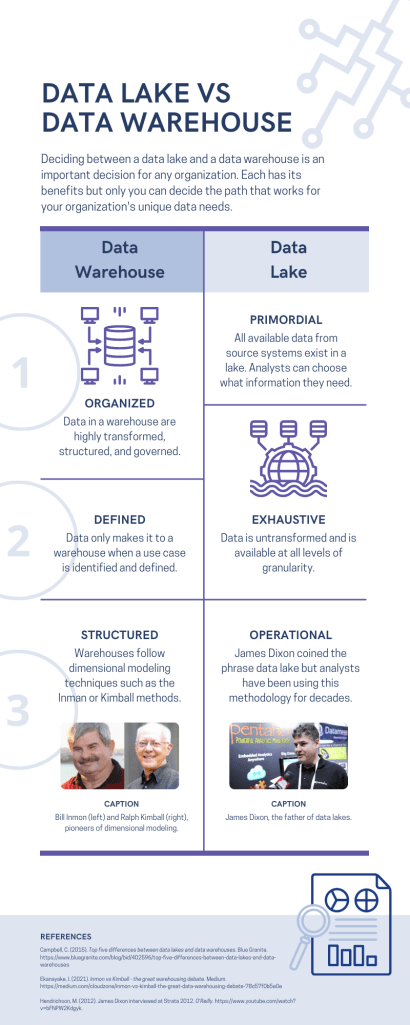
Data Lake vs Data Warehouse Infographic
This infographic was created for my Strategic Communication Masters Capstone course, COMSTRAT 701, in the spring term of 2022. The professor for this course was Rebecca L. Cooney. COMSTRAT 701 examines how well students apply best practices for both digital and print platforms within industry standards. This course was a culmination of all concepts learned throughout my graduate program at Washington State University.
The infographic assignment was part of a series of creative activities through which students demonstrate their expertise as professional communicators with originality and creativity. This infographic incorporates my work in business intelligence, and design concepts learned throughout my studies in strategic communication. Since my profession involves data modeling concepts, I’m well versed in the content outlined in the infographic. When deciding how to present data to the business, leaders in business intelligence often have to choose between a data warehouse, data lake, or both. I chose to illustrate this decision for the infographic assignment because it tied together my work and studies.
Before I tackled the infographic, I spent a few hours outlining what I wanted to include in a Microsoft Word document. Once I had the comparison outlined, I began to play around with infographic templates in Canva. Canva is a fantastic tool for quickly creating visually appealing content. The overall assignment took about four hours to complete between creating graphics and formatting the text. I hope you enjoy the infographic and find it useful for your own data storage decisions in the future.
Equifax Data Breach Media Crisis
I created this piece for my Strategic Communication Masters Capstone course, COMSTRAT 701, in the spring term of 2022. For more details about this course, scroll up on this page to the infographic overview. The media crisis assignment was part of a series of prompts designed to validate graduate students’ competency level in each of the program’s core focus areas. This assignment demonstrates my ability to assess a media crisis by examining an organization’s strategies in response to a crisis and the resulting impact.
This assignment took me about 20 hours to complete. I used various tools, including Microsoft Word, Canva, and my school’s online library for research. The first thing I did was outline the required sections in Word. Then, I typed out everything I could remember from the crisis as an observer. Next, I validated what I could remember through research and filled in the gaps with online news articles, scholarly research, and social media commentary from the crisis. I pulled together media that I wanted to include from Equifax’s website and other journal articles from my research. Once I completed my draft, I started looking for a suitable template in Canva. I incorporated Equifax’s official color palette into my document to visually align with their logo, which is featured throughout. I also used data from their about page and a timeline of events I found online to design original infographics in Canva. You can find those infographics on pages 2 and 3 of the document below.
I hope you heed this cautionary tale of what happens when a company doesn’t properly prepare for a crisis and take action for your own organization today.
My First Year in CRM
I created the blog below for the Multimedia Content Creation course, COM561, in the spring term of 2019. COM561 was my first class in my graduate program at Washington State University. While I’ve come a long way since then, I still want to feature this work because it was foundational to all I’ve learned in grad school. The purpose of COM561 was to develop and communicate ideas clearly, concisely, and effectively through multimedia content. The blog represents the contents of the course and my progression through the concepts I learned.
It took me three months to create this blog in its entirety. For the written content, I used tools like Microsoft Word and Grammarly. For the technical content, I used a different advanced Adobe tool to complete an assignment for each blog section, including Illustrator, Premiere, and Audition.
For each assignment, I published my process and final results on a WordPress blog for peer review. Here’s an example of how I used Adobe Premiere to edit together content for the blog:
I’m still proud of this early work. I hope you enjoy my learning journey linked below.


Get Active with Rosemarie
This portfolio piece is the culmination of work completed across two courses in my graduate program, COMSTRAT 561, Persuasion for Professional Communicators, and COMSTRAT 565, Professional Marketing Communication Management Campaigns. I took COMSTRAT 561 in the summer of 2019 and COMSTRAT 565 in the Fall of 2021.
For COMSTRAT 561, we were asked to showcase persuasive theories in a unified theme. I chose the theme of “a healthy active lifestyle” and demonstrated persuasive theories like inoculation, central processing, theory of reasoned action, social learning theory, and agenda-setting. The initial campaign included a Facebook group and a blog with mirrored content.
In COMSTRAT 565, I modified the Get Active with Rosemarie communications campaign to illustrate mastery of campaign management from analysis to execution. I conducted market research on my COMSTRAT 561 content and made modifications to both the blog and Facebook page based on feedback from my audience. Research participants were asked about font, verbiage, imagery, and content. The qualitative research provided actionable insights, which helped me launch the refreshed blog you see hosted on my site today. Please visit the blog category, Get Active with Rosemarie, to view the final curated content from this campaign.
Wrecking Ball Garage
I created this piece, and the one following, for my Strategic Communication Masters Capstone course, COMSTRAT 701, in the spring term of 2022. For more details about this course, scroll up to the first portfolio piece at the top of this page. For this assignment, we were asked to create a social media style guide for an organization of our choice. The purpose of the exercise was to demonstrate our mastery of social media outreach combined with a demonstrated ability to apply purposeful research. An outline and template were provided but our professor gave us creative freedom from there.
I chose my brother’s company, Wrecking Ball Garage, as the focus for this project. I started with a brief interview to determine his vision, mission, voice, and tone for his company. I then asked some questions about his audience so I could get to know a bit about who he’s trying to reach with his content. I logged all of his answers on the template provided in Microsoft Word. Based on his answers, I started to develop a theme for the presentation. I looked through his Instagram page for images that would be appropriate for the look and feel I had in mind.
Once I gathered all of my material together, I created a logo using Canva. I incorporated simple shapes and a creative commons image of a wrecking ball. My brother loved the new logo so much that he immediately updated his Instagram profile pic with the new image! That was such high praise so I felt good about the direction I was going.
I then found a presentation template on Canva that matched the look I was going for and started plugging in my content. All in all, I spent about 24 hours total on the social media style guide you see below. In addition to providing valuable content for my brother’s company, I have an even greater love of Canva for content creation. I hope you enjoy the finished product and visit Wrecking Ball Garage to see the new style guide in action.
My Journey to Graduation
Like the piece above, I created My Journey to Graduation for my Masters Capstone course, COMSTRAT 701, in the spring term of 2022. For more details about this course, scroll to the top of this page. My Journey to Graduation was a digital storytelling assignment, part of a series of prompts designed to validate graduate students’ competency level in each of the program’s core focus areas. This assignment demonstrates my ability to create a digital campaign and tell a story through digital communication tools. I created two social media posts using Canva, a blog post, an HTML email with Constant Contact, and an Adobe Creative Cloud Express web page.
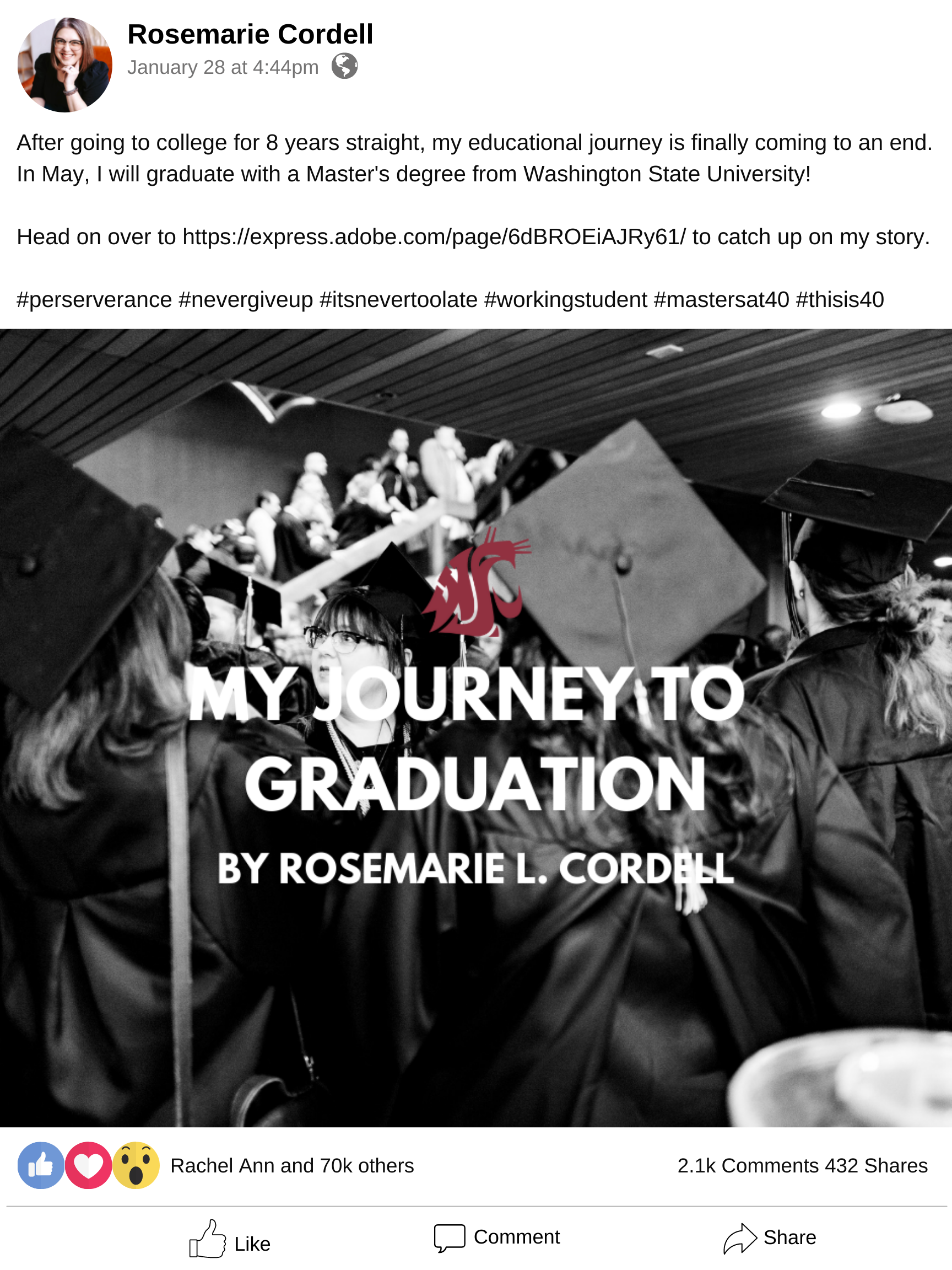
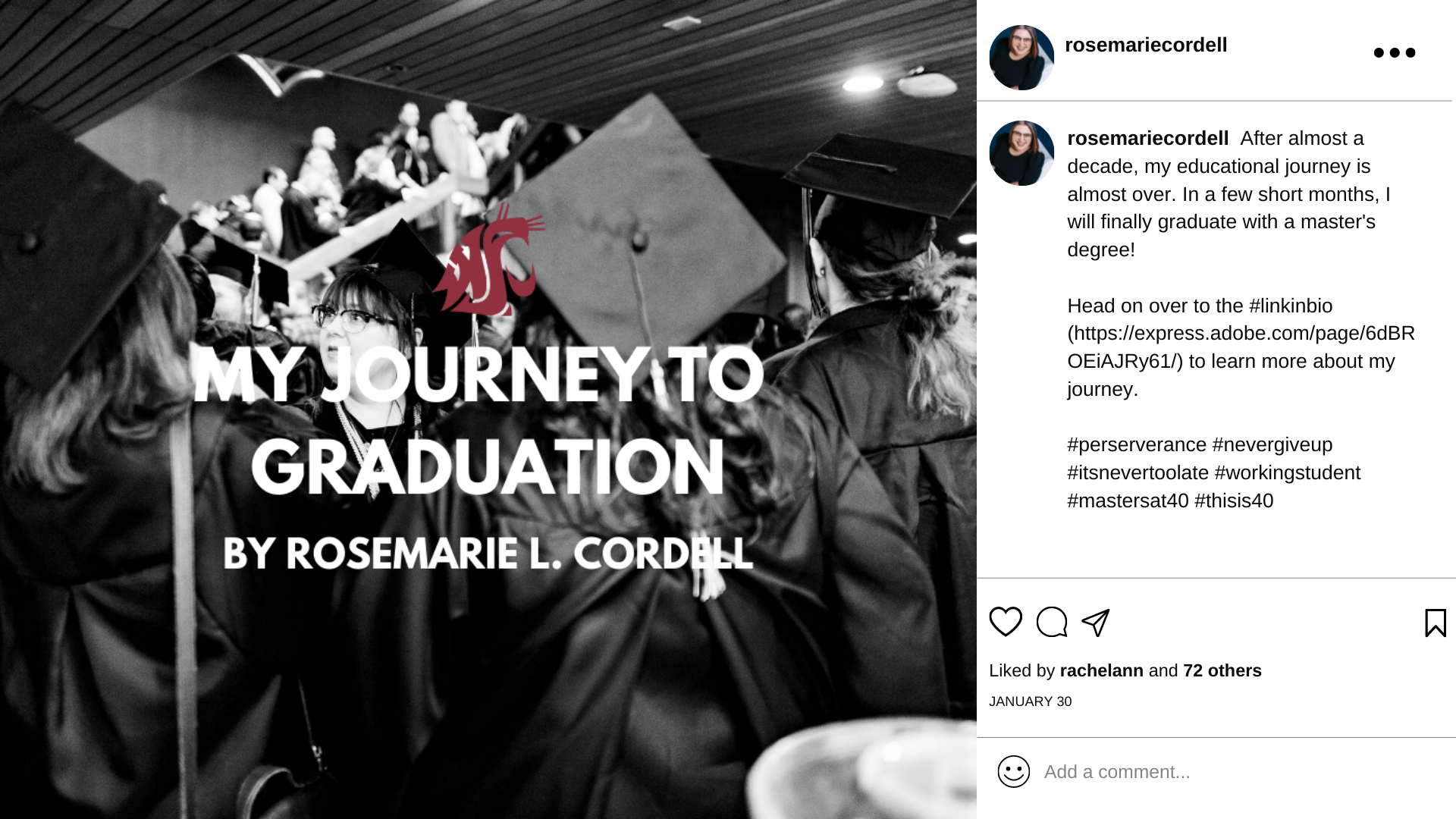
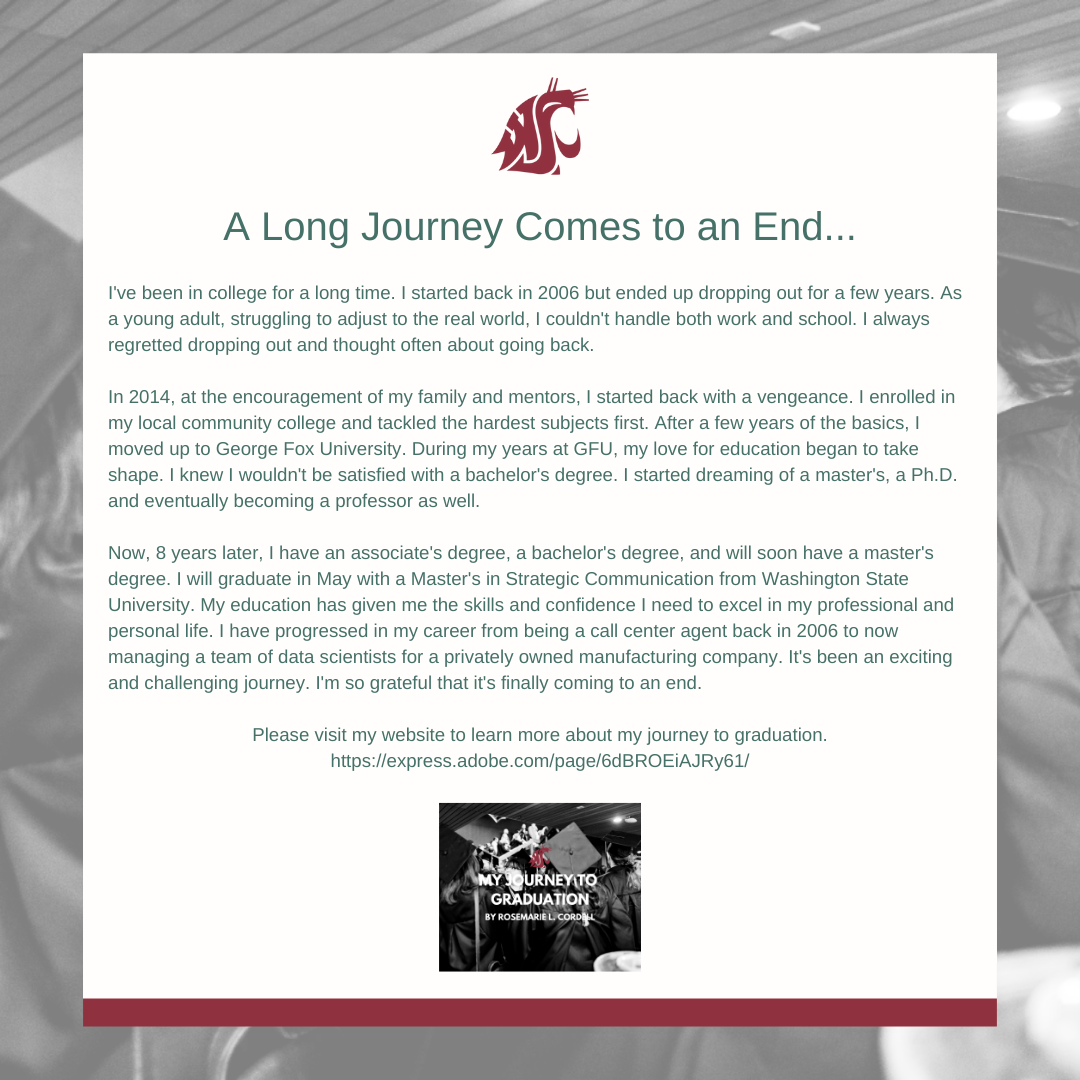
The entire assignment took me about 18 hours to complete from planning, design, and implementation.

 Rosemarie L. Cordell